$717.57. That covered the first treatment, a shampoo and a cleanser.
That’s the number, up top, because it’s the thing every page about this treatment refuses to tell you.
This is the first of a monthly series. Once a month I’ll put up what happened, what it cost, and what my scalp looks like, the same way I put up the weight whether or not it moved. Today is session one of somewhere between four and six. I have no results. That’s sort of the point of writing it down now instead of in six months when I’ve decided how I feel.
What Alma TED is
TED stands for Trans-Epidermal Delivery. It’s a device made by Alma Lasers, and there’s no laser involved despite the name.
Flatly: ultrasound and air pressure open temporary micro-channels in the top layer of the scalp, and a serum gets driven down through them instead of sitting on top doing nothing. No needles, no injections, nothing numbing. Mine used growth factors, with additional focus through the frontal region.
The pitch is that scalp treatments mostly fail at the delivery step rather than the ingredient step. The stuff works, it just never gets anywhere. This is sold as the fix for that.
What it cost, and what the internet says it costs
The articles I read put a single session around $1,250, and a package of three near $3,600.
My clinic posts its prices, which I appreciated more than I expected to:
| TED treatment | $800 |
| Hair + scalp analysis | $200 |
| Hair + scalp follow-up | $100 |
| Treatment consultation | $50 |
So $1,250 is not the number everywhere. Call more than one place.
My $717.57 came in under that posted $800 and still had two products in it. I don’t know why. I didn’t ask at the desk, and I’d rather leave a number unexplained than invent a reason for it. I’ll ask at the next session and put the answer in month 1.
The part nobody puts in a headline: it isn’t three sessions and done. My plan is four to six treatments over four to six months, then maintenance roughly every four to six months after that. Indefinitely.
At the posted $800, a course of four to six is $3,200 to $4,800, and then something like $1,600 to $2,400 a year, every year, to hold whatever I end up with. What I actually pay may differ, as it did this time. I’ll report the real figure each month and let the running total speak for itself.
I’m not being dramatic about it — I knew roughly what I was signing up for. I’m writing it down because “$800 a session” and “this is a subscription” are two different pieces of information, and only one of them is easy to find.
What they actually found
Before anything happened they looked at my scalp under a microscope. This was the part I wasn’t expecting and the part I’ve thought about most since.
The finding was follicular miniaturization consistent with androgenetic alopecia — male pattern hair loss. The front is further along than the back, though there’s early miniaturization back there too.
The encouraging half: there are still plenty of fine, active hairs in the thin areas, and very few completely empty follicles. That’s what makes me a candidate. The goal isn’t conjuring hair out of bare scalp. It’s thickening hairs that are still there and holding onto the follicles I’ve got.
Which is a more modest promise than the one in the advertising, and I trust it more for being modest.
What the session was actually like
Instructions beforehand: wash your hair the night before, because you can’t wash it for 24 hours afterward.
The treatment itself: I felt nothing. Not “manageable,” not “a bit of discomfort” — nothing. No pain, no sting, no pressure worth reporting.
The machine is loud. That’s the only thing about it that registers. And even then, not loud enough to stop me holding a full conversation with Megan through the whole appointment.
Twenty minutes, maybe thirty. I didn’t time it, which tells you something about how much of an ordeal it wasn’t.
You walk out with the serum still in, so your hair looks like you showered and skipped the towel. And you leave it that way — no washing for 24 hours.
What it looked like an hour later
These were taken about an hour after I walked out, with the serum still in — why the hair looks damp and the pale strands catch the light.
They are not the baseline. The baseline is a dry set shot a few days later, and that’s what every future month gets measured against. I’m putting these up anyway, because they’re the only straight-afterwards photos I’ll ever have.
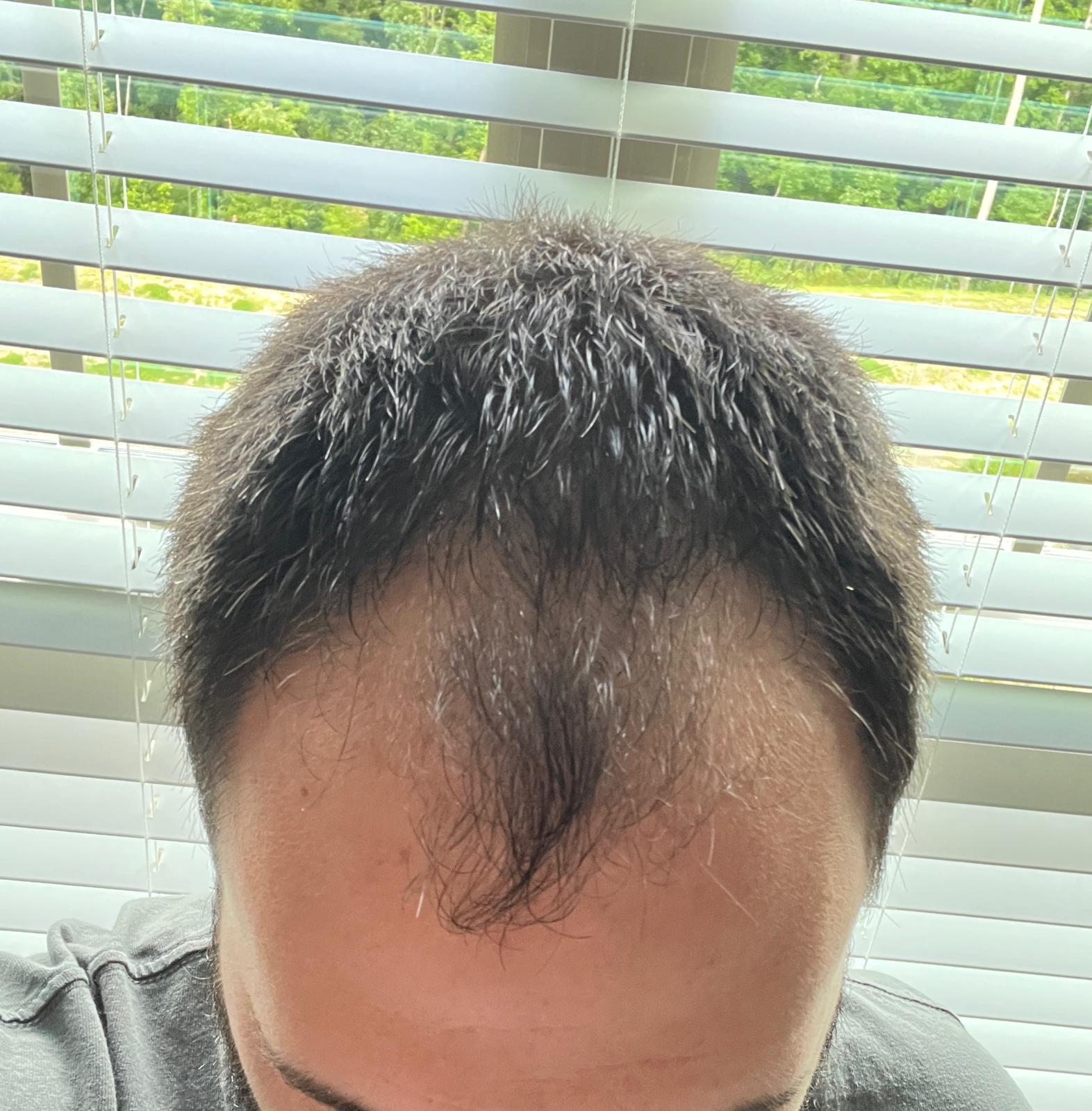
The front is what Megan flagged as furthest along. That’s the recession at the temples, and it’s the part I’d been styling around without admitting I was styling around it.
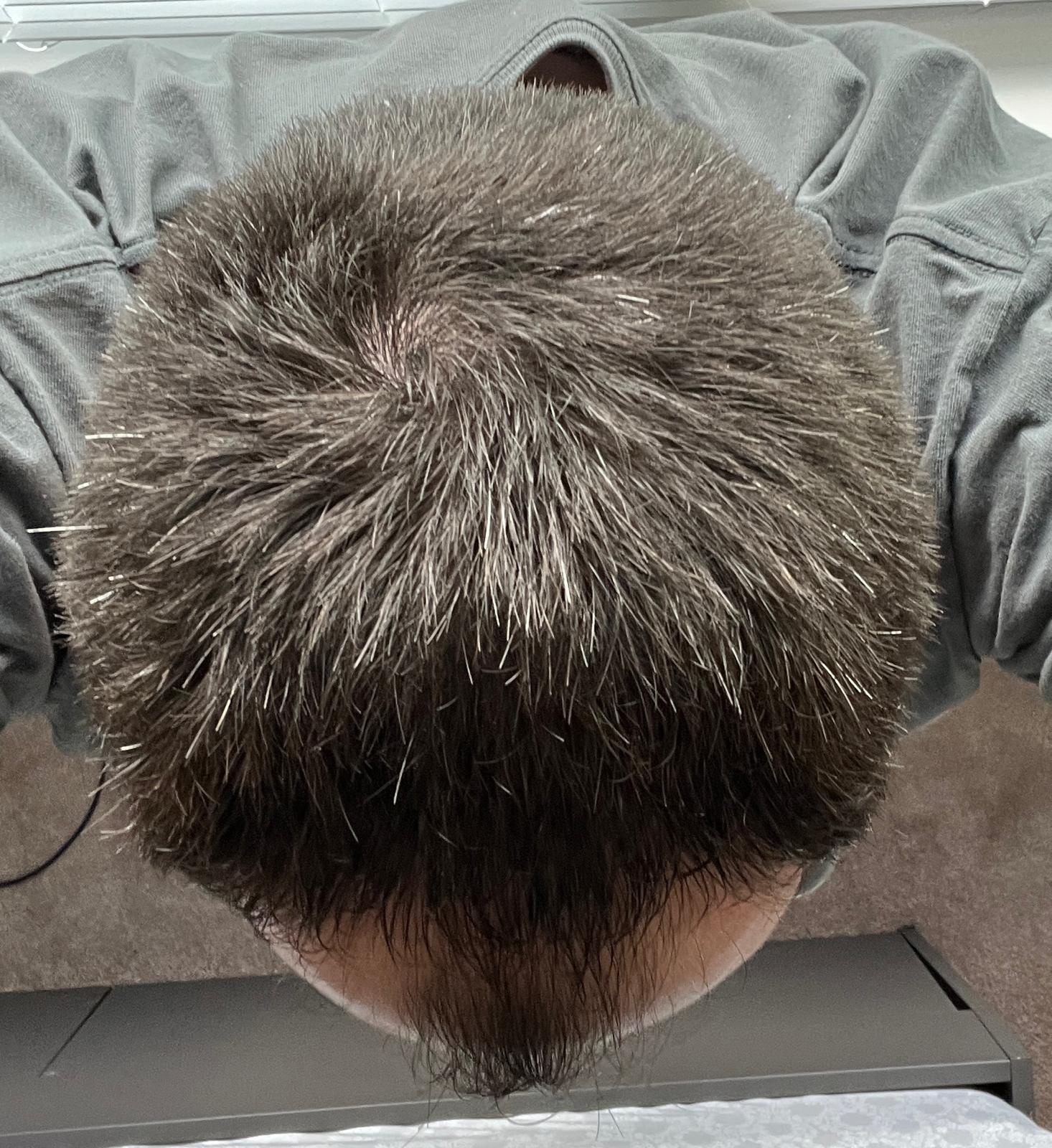
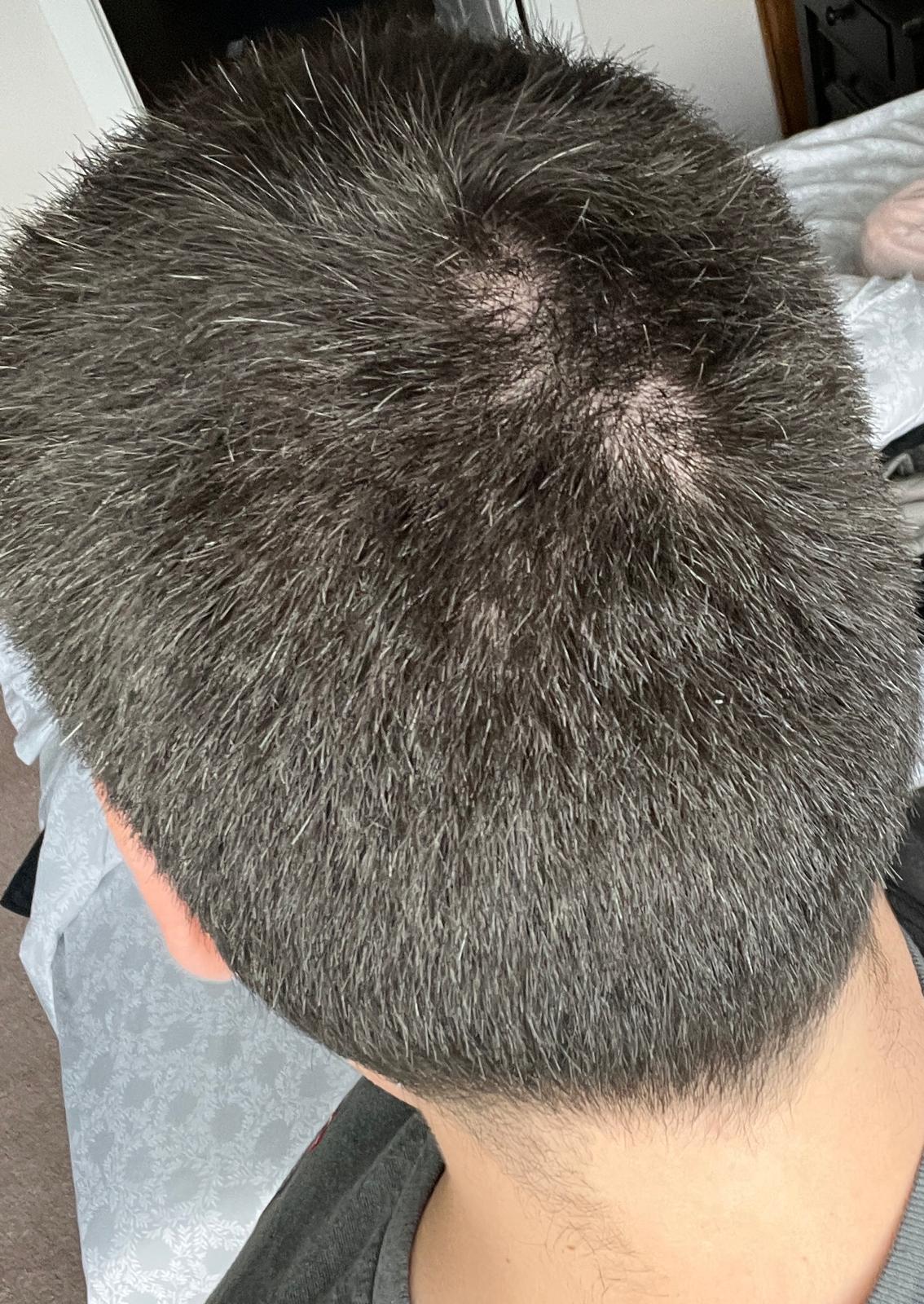
That last one is the one that got me. Two thin patches I had never seen, because they’re on the back of my head and I have never once looked at the back of my head.
One thing to hold onto when you look at these: the front got the extra focus, because the front is where the miniaturization is furthest along. So the hairline is the fair test. If something changes back here it’s a weaker signal, and I’ll say so at the time rather than quietly counting it.
The homework, and the thing I was told not to do
At home: wash daily or every other day, about half a pump of the growth support shampoo, shampoo twice. Calm spray daily and after workouts, since I sweat. Hat on for long stretches in the sun.
Then the instruction I keep coming back to. Hold off on red-light therapy. No oils. No at-home dermarolling. Not because they’re useless — some of them may help later, for extending results — but because if I start four things this month, nobody can tell which one did anything.
She said it as routine clinical housekeeping. I heard it as the most honest thing anyone has said to me about hair loss.
Why that one instruction is the whole post
I read the write-ups before I booked. The one that moved me most was a PopSugar writer’s account of the full three-session course. Nothing after session one, real regrowth at the temples by two, a clear difference by three. I’ve no reason to doubt a word of it.
I’d only point at what else was in the experiment. Her serum carried dutasteride, minoxidil and bimatoprost — three drugs with their own established record for hair. And after session two she added an oral supplement on her doctor’s advice.
Four things changed. The hair improved. The headline credits the device.
That may be exactly right. It’s also not something that account can establish, and it’s not something mine could either if I ran it that way. So I’m not running it that way — not by my own discipline, but because the person doing the treatment told me not to and explained why.
Mine is growth factors, nothing else, no red light, no oils, no roller, and a reassessment under the same microscope in four weeks. Whatever happens, the result will actually mean something. That’s rarer in this industry than it should be, and it’s the reason I’m willing to write about it in public.
Same reason I won’t tell you the walking is what moved my weight. I changed several things at once, like everyone does.
Why a hair treatment is on a weight loss site
Read the clinical material on who this treatment is for and the list runs pattern baldness, hormonal changes, autoimmune conditions — and extreme weight loss.
I’m down from 293 in January to 280 now. Thirteen pounds in seven months is not extreme by any measure, and I’m not going to stand here implying my hair is a casualty of some dramatic transformation I haven’t had. My diagnosis is the ordinary one. It’s genetic, it’s the most common kind there is, and it was coming for me either way.
But I didn’t know the two things sat on the same list, and now I do. This site is a log of one slow thing I don’t control. Turns out there’s a second one running alongside it, and I’d been not looking at that one for years.
What I can’t tell you
Whether it works.
I’ve had one session. What I was told it does — more blood flow, nourished follicles, new growth — is the clinic’s language and I’m handing it to you as theirs, not adopting it as mine. Reassessment is in four weeks. Published guidance says results keep developing over about six months after the initial course.
So the earliest this can hold a real answer is around February, and even then “real” means what the microscope says, not what I’ve talked myself into seeing in the mirror.
And the uncomfortable bit: I paid for this. That makes me the least reliable judge available of whether it was worth it. True of every enthusiastic first-person review of anything, including the ones that put me in the chair.
The deal for this series
Once a month. What was done, what it cost, what the reassessment says, and photos from the same angles in the same light.
If in six months my hairline is exactly where it started and I’m three or four thousand dollars down, that post goes up too, in the same font as a good one. Same rule the scale gets. A log that only publishes wins is an ad with extra steps.
Nobody is paying me for this. No affiliate link, no comped session, no brand deal, and nothing knocked off in exchange for writing about it — the clinic doesn’t know this post exists. I found the place, I booked it, I paid $717.57 of my own money. If any of that ever changes it’ll say so at the top of the post, not in a footer.
Weigh-ins continue as normal. This doesn’t move that number and I won’t pretend it does.
That’s month zero.